Textile fabrics are broadly divided into wovens, knits, and non-wovens. Within the knit family there is a fundamental split: weft knitting and warp knitting. The distinction is deceptively simple but has profound structural and performance consequences.
In weft knitting (think of hand-knitting or a circular-knit jersey), a single yarn — or a small set of yarns — travels horizontally across the fabric width, forming loop after loop in successive courses. In warp knitting, a separate yarn is allocated to every needle across the machine width, and all yarns move simultaneously in the machine direction. Each yarn forms loops that interlock with those of its neighbors, producing a fabric in which loops are chained along the length (wale direction) while the yarns also swing laterally from needle to needle to create the interlocking structure.
This structural difference leads to several defining characteristics of warp-knitted fabrics. They are run-resistant — a broken loop does not cascade down a column as it would in weft knitting — and they exhibit greater dimensional stability in both the length and width directions. Depending on the stitch structure selected, warp knits can range from highly porous open meshes to completely opaque dense constructions.
The origins of warp knitting trace to 17th-century England, where silk framework knitters began adapting stocking-frame technology to create fabrics that could not unravel when a yarn broke. The first purpose-built warp-knitting machine — generally attributed to Hammond and Morris — appeared around 1775 and used a bar of hooked needles fed by a beam of warped yarns, an arrangement that remains conceptually unchanged in modern equipment.
The 19th century saw warp knitting transform from a cottage industry into an industrial staple. The introduction of the Raschel machine (named after the French actress Rachel, whose lace costumes popularized open-work fabrics) expanded the range of achievable structures dramatically. By the early 20th century, the tricot machine — derived from the French word for knitting — had become the standard platform for high-volume fabric production, particularly with the rise of synthetic fibers after World War II.
Nylon and, subsequently, polyester transformed warp knitting economics. The ability to process continuous-filament synthetic yarns at high speed gave the technology a decisive cost advantage for commodity fabrics. The 1970s and 1980s brought computer-controlled pattern bars and electronic guides, while the 1990s and 2000s saw the adoption of carbon-fiber and technical yarn capabilities, opening up aerospace and medical end-uses.
Today, warp knitting is a global industry concentrated in Germany (Karl Mayer is the dominant machine builder), Japan, China, Taiwan, and India. Zhejiang province in China has emerged as a particularly important center, with clusters of manufacturers producing everything from base-fabric greige goods to fully finished, value-added textiles.
Two main machine families dominate warp knitting: Tricot machines and Raschel machines. While both share the same fundamental operating principle — a warp beam supplies thousands of parallel yarns to a needle bar — their engineering configurations produce very different fabric capabilities.
Tricot machines use spring-beard or compound needles operating in a trick-plate (sinker bar). They run at the highest speeds — commonly 2,000–3,500 RPM on modern equipment — and are ideally suited to fine-gauge, close-structured fabrics. Machine gauges typically range from E18 to E44, where the gauge number (E) denotes the number of needles per inch. Fine-gauge tricot (E28 to E44) produces fabrics with tight, smooth surfaces widely used in lingerie, sportswear linings, and interlinings.
Most tricot machines carry two or three guide bars (GB1, GB2, GB3), each capable of a different lap notation. Adding a third bar allows the production of patterned fabrics, simple jacquards, and inlay structures. Some specialty machines carry four or more bars for multibar lace or technical constructions.
Raschel machines use latch needles, which are more robust and can handle coarser, less regular yarns, including elastics, tapes, and novelty yarns. Running speeds are lower than tricot (typically 400–1,200 RPM) but the machines are far more flexible in terms of the structures achievable. Raschel machines may carry anywhere from 2 to 78 guide bars, enabling the production of lace, spacer fabrics, nets, technical textiles, and complex multibar constructions.
Machine gauge directly determines the maximum thread density and hence the achievable fabric weight and cover factor. A fine E40 tricot runs with 40 needles per 25.4 mm (1 inch) of needle bar, allowing extremely fine yarns at high loop densities. Increasing the number of courses per centimeter (CPC) — controlled by the fabric take-up mechanism — adds weight and changes the loop aspect ratio, affecting handle and opacity.
The design language of warp knitting is the lap diagram and its numerical notation. Each guide bar is described by a series of numbers separated by slashes, with each pair of digits representing the overlap and underlap movement at consecutive knitting cycles. The notation is based on needle-space coordinates.
Three foundational structures underpin the vast majority of commercial warp-knitted fabrics. Understanding them demystifies the seemingly endless variety of trade names and descriptions encountered in the market.
| Structure | Notation (GB1 / GB2) | Characteristics | Common Uses |
|---|---|---|---|
| Plain Tricot (1-and-1) | 1-0 / 1-2 | Lightest, softest; moderate stretch in width; run-prone if single bar | Lingerie linings, interlinings |
| Locknit | 1-0 / 2-3 | Good cover; balanced stretch; smooth face; typical 2-bar construction | Sportswear, blouses, overlays |
| Sharkskin | 1-0 / 3-4 | Higher yarn consumption; full cover; thicker handle than locknit | Swimwear, activewear panels |
| Satin | 1-0 / 5-4-3-2 (4-bar) | Lustrous face; thick underlap gives weight and opacity; slight warp bias | Lingerie, fashion linings |
| Velvet / Pile | Pillar + inlay bar(s) | Loop pile or cut pile; rich texture; dependent on pile height | Home décor, fashion, upholstery |
| Raschel Lace | Multi-bar (6–78 bars) | Open, patterned; infinite design freedom; slow production | Lingerie, bridal, apparel trims |
| Spacer Fabric | Two outer layers + monofilament pile bar | 3D sandwich; thermal insulation; cushioning; air permeability | Shoes, protective gear, car seats |
The underlap — the portion of yarn that passes behind the needles between successive overlaps — is arguably the most powerful design variable in warp knitting. A short underlap (1–2 needle spaces) produces a lightweight, open fabric with high stretch; a long underlap (3–6 or more spaces) builds up yarn on the technical back of the fabric, adding weight, opacity, and dimensional stability, and is the basis of fabrics like velour where the underlap yarn is raised into a surface pile.
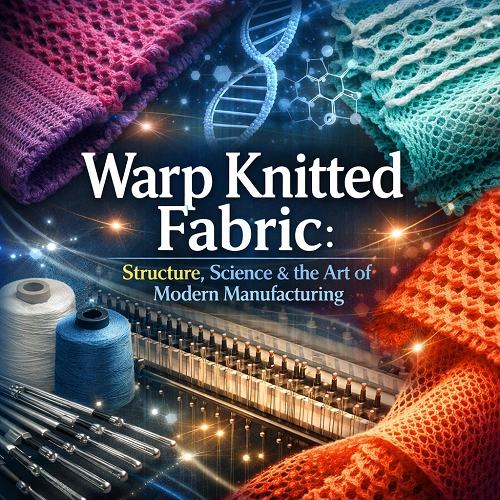
Unlike weaving, warp knitting does not subject yarns to the intense frictional loading of a shuttle loom, which means a somewhat wider range of yarn types can be processed. Nevertheless, warp knitting still imposes significant yarn requirements, particularly around elongation, tenacity, and yarn evenness.
Polyester is the dominant fiber in warp knitting, accounting for the majority of global production. Fully drawn yarn (FDY) and partially oriented yarn (POY) texturized via air-jet or false-twist processes are the staple inputs. Polyester's high tenacity, moderate elongation, and excellent thermoplastic behavior — which allows heat-setting to lock in dimensional stability — make it ideal for tricot production. Semi-dull and bright luster variants serve different end-use requirements: semi-dull is preferred for sportswear, while bright variants add sheen to fashion fabrics. At Wanjie Textile's Sportswear Series, polyester is central to performance fabric development.
Nylon 6 and Nylon 6,6 offer superior abrasion resistance and a softer, silkier hand compared to polyester at equivalent fineness. These properties make nylon the preferred choice for intimate apparel, hosiery, and high-performance sportswear, particularly where skin contact and tactile quality are critical. Nylon's moisture-absorption advantage over polyester (circa 4% vs. 0.4% regain) translates to more comfortable next-to-skin wear, though it does impact dye stability and color fastness.
Elastane is almost never used as the sole yarn in warp knitting; instead, it is combined — often inlaid — with a structural yarn. Its extraordinary elongation (up to 600%) and elastic recovery transform otherwise dimensionally stable fabrics into the stretchable, body-conforming materials demanded by swimwear, activewear, and shapewear. Wanjie's Spandex Series exemplifies this approach, offering fabrics that balance support, freedom of movement, and durability.
Viscose (rayon) and modal are sometimes processed on warp-knitting machines for softer, more absorbent fabrics with a natural fiber aesthetic. Cotton warping is technically challenging due to natural fiber irregularity but is used for specialized applications. At the technical extreme, high-performance fibers such as Kevlar, carbon fiber, and glass fiber can be processed on adapted warp-knitting machines to produce composites used in aerospace, defense, and civil engineering.
The warp-knitting process is a platform, not a product. The variety of commercially available warp-knitted fabrics is vast, but several categories account for the majority of global output. The following profiles each of the principal types, with references to specific product lines where available.
The archetypal warp-knit fabric: smooth, lightweight, relatively inextensible in the length direction and moderately stretchable in the width. Tricot fabrics are produced at the highest speeds and are the foundation of the lingerie industry as well as softshell jacket linings, casual blouses, and performance underlayers. Filament polyester and nylon are the primary inputs.
Warp-knitted velvet is produced by raising or shearing the long underlap loops of a specially constructed base fabric, creating a dense cut pile on the fabric face. The construction differs fundamentally from woven velvet, which relies on an extra set of warp or weft threads. Knitted velvet is typically lighter, more flexible, and easier to sew — advantages that have made it the dominant form for fashion and home décor. Wanjie Textile's Velvet Series includes both standard velvet and specialty varieties such as burnout velvet and stretch velvet for fashion and interior applications.
Mesh fabrics achieve their characteristic open structure by creating deliberate gaps in the fabric through careful stitch design. Common mesh constructions include powernet (used in shapewear), athletic mesh (used in sports jersey panels for ventilation), and fashion mesh (used in overlay layers). The specific aperture size, shape, and distribution are determined by the lap notation and the number of guide bars engaged. Wanjie's Mesh Series offers breathable, lightweight mesh materials optimized for sportswear and fashion accents.
Warp-knitted corduroy represents a modern interpretation of a classic woven structure. By introducing laid-in yarns at intervals across the fabric width and subsequently cutting or raising these to form ridged pile cords, manufacturers can produce a corduroy-like surface with greater extensibility and comfort than the woven equivalent. Wanjie's Corduroy Series leverages this technology to deliver versatile fabrics suitable for both apparel and home décor.
The addition of elastane — typically between 10% and 30% by weight — transforms the stretch and recovery characteristics of a warp-knit base fabric. Elastane is usually inlaid rather than knitted, meaning it is held in place by the structure of the surrounding yarns without forming loops itself. This preserves the yarn's elastic integrity while integrating it seamlessly into the fabric. The result is the characteristic four-way or two-way stretch performance critical in swimwear, cycling shorts, yoga pants, and compression garments. Wanjie's Spandex Series specifically addresses this high-growth segment.
Burnout (devore) warp-knitted fabrics are created by selectively destroying one component fiber in a blend fabric using a chemical paste — typically a strong acid or alkali — leaving behind a pattern of sheer, transparent areas against an opaque background. When applied to a polyester/viscose blend tricot, for example, the acid dissolves the viscose while leaving the polyester structure intact, creating the characteristic semi-transparent, patterned appearance. Wanjie's Burnout Series encompasses these eye-catching, design-forward fabrics.
Nylon/Polyester Spandex constructions engineered for superior flexibility, compression, and moisture management.
View Series →Luxurious pile fabrics in cut velvet, burnout velvet, and stretch velvet for fashion and interiors.
View Series →Breathable, open-structure fabrics optimized for sportswear ventilation panels and fashion overlays.
View Series →Elastane-integrated warp knits delivering four-way stretch for activewear, swimwear, and shapewear.
View Series →Warp-knit corduroy with comfort stretch and dimensional stability, ideal for apparel and home décor.
View Series →Devore and burnout velvet constructions producing semi-transparent patterned effects for high-fashion end-uses.
View Series →The performance profile of a warp-knitted fabric is the cumulative result of fiber selection, yarn count, machine gauge, stitch notation, and finishing. The following section discusses the key measurable properties and the structural levers available to optimize them.
One of the most commercially significant advantages of warp knitting over weft knitting is dimensional stability. Because each yarn runs predominantly in the wale direction and the lateral connections are deliberate underlaps rather than looping yarns, warp-knitted fabrics resist stretching in the length direction under normal use conditions. Heat-setting polyester or nylon fabrics on a stenter frame after dyeing locks in the desired finished width and length permanently, providing the stable cut-and-sew behavior required in garment manufacturing.
Warp-knitted fabrics generally exhibit good bursting strength because the loop structure distributes localized stresses across multiple yarns. The run-resistant nature of warp knitting means that an isolated fiber break does not propagate as it would in a weft-knit structure, contributing to overall durability. Tear resistance can be further enhanced by increasing underlap length, adding inlay yarns, or using higher tenacity fibers such as high-tenacity polyester.
In sportswear applications, moisture transport is critical. Warp-knit structures can be engineered for wicking by combining a hydrophobic inner layer (which repels sweat away from skin) with a hydrophilic outer layer (which spreads and evaporates moisture). This is typically achieved using differential cross-section fibers or fiber blends in conjunction with appropriate stitch structures that promote capillary action across the fabric thickness.
Mesh and open-work warp-knit constructions offer predictable, consistent air permeability that is difficult to achieve with woven or non-woven alternatives. The aperture geometry — determined by the lap notation — can be held to tight tolerances across the full fabric width, enabling repeatable performance in applications such as protective screen fabrics, agricultural shade nets, and sportswear ventilation panels.
Pilling — the formation of small fiber balls on the fabric surface from loose fiber ends — is less pronounced in filament-yarn warp knits than in staple-fiber equivalents because continuous-filament yarns have no fiber ends to escape and tangle. However, the loop structure does expose yarn to surface abrasion, and pilling can still occur in heavier-gauge fabrics under sustained abrasion. Fabric finishes such as shearing (for velvet) or singeing partially mitigate this.
Greige (unfinished) warp-knitted fabric undergoes a multi-stage wet and dry processing sequence before reaching the end consumer. The specific sequence depends on the fiber content, fabric construction, and end-use requirements.
The first wet process removes spin finish, sizing agents, and manufacturing contamination. For polyester tricot, this typically involves passage through a continuous open-width scourer at 60–80 °C with a non-ionic detergent. Relaxation allows residual tensions from the knitting process to dissipate, stabilizing the fabric dimensions before dyeing.
Polyester warp-knitted fabrics are dyed with disperse dyes at high temperature (130 °C) and pressure using jet dyeing machines or jiggers. Nylon uses acid dyes at near-boiling conditions. Elastane-containing fabrics require carefully controlled dyeing temperature and time to avoid degradation of the elastomeric component. Color fastness — to washing, light, perspiration, and rubbing — is a primary quality benchmark and is tested according to standardized methods (ISO 105 series).
Heat setting is a defining process for synthetic warp-knitted fabrics. Passage through a pin stenter at temperatures of 180–210 °C (for polyester) crystallizes the polymer structure, permanently fixing the fabric width and length dimensions and imparting the flat, stable handle needed for garment cutting. Heat setting also improves color uniformity by relieving differential strains that would otherwise cause dye-uptake variation.
The finishing stage is where engineered performance is added. Common functional finishes applied to warp-knitted fabrics include durable water repellency (DWR) for outerwear, antimicrobial treatments for activewear, ultraviolet protection factor (UPF) enhancement for swimwear, and softening agents for intimate apparel. Increasingly, brands require certifications such as OEKO-TEX Standard 100 or bluesign to verify the safety and environmental credentials of these chemical treatments.
The breadth of warp-knitted fabric applications reflects the technology's capacity to deliver engineered performance across a wide spectrum of structural and aesthetic requirements. The following surveys the principal end-use sectors.
Activewear is perhaps the most visible growth sector for warp-knitted fabrics. The combination of four-way stretch, moisture management, dimensional stability, and production efficiency makes warp-knitted polyester/nylon/elastane constructions the fabric of choice for leggings, sports bras, cycling apparel, running shorts, and performance base layers. The ability to create zoned compression within a single fabric piece — by varying stitch tension or inserting higher-denier inlay yarns in selected areas — has enabled a new generation of functional activewear that supports muscles while maintaining freedom of movement. Wanjie Textile's Sportswear Series addresses precisely this market, providing durable nylon and polyester spandex fabrics designed for superior performance.
Competitive swimwear demands extreme chlorine resistance, colorfastness in pool and seawater environments, fast-drying behavior, and dimensional recovery after repeated wet/dry cycling. Warp-knitted nylon/elastane fabrics, combined with PU-membrane lamination in some cases, meet these stringent requirements. UPF ratings of 50+ are routinely achieved by adjusting fabric weight and cover factor.
The lingerie sector was one of the earliest adopters of warp-knit technology and remains a major consumer. Fine-gauge nylon tricot provides the smooth, frictionless lining characteristic of premium intimate apparel; power-net constructions (Raschel-produced) deliver the structured support of bra cups and shapewear panels; Raschel lace provides the decorative detailing that defines luxury lingerie aesthetics.
Warp-knitted velvet, corduroy, and printed tricot fabrics are widely used in home textiles: upholstery covering, curtain fabrics, scatter cushion covers, and decorative throws. The dimensional stability and reproducible pile height of knitted velvet are particularly valued in upholstery, where consistent surface quality across large panels is essential. Wanjie's Corduroy Series and Velvet Series both cater to this sector.
Beyond performance applications, warp-knitted fabrics are a staple of casual fashion: stretch denim alternatives, burnout chiffon overlays, printed jersey blouses, and embossed velvet skirts. The ability to print, emboss, laser-cut, and chemically treat warp-knitted fabrics using a wide range of downstream processes extends their design versatility far beyond what the raw grey fabric might suggest.
At the technical end of the spectrum, warp-knitted structures serve in geotextile stabilization, medical bandaging and compression therapy, automotive seating and headlining, filtration media, and composite reinforcement. The capacity to incorporate glass fiber, carbon fiber, and aramid yarns on adapted Raschel machinery has opened up structural composite applications in aerospace and civil engineering, where the near-net-shape knitted preform reduces material waste compared to woven laminates.
The textile industry is under significant and growing pressure to reduce its environmental footprint, and warp knitting is not exempt. Several trends are reshaping the sustainability profile of warp-knitted fabric production.
Recycled polyester (rPET), derived from post-consumer plastic bottles or textile waste, is increasingly used as a drop-in replacement for virgin polyester in warp-knitting operations. rPET offers comparable tenacity and processability to virgin material while significantly reducing the fossil-fuel input and carbon emissions associated with fiber production. GRS (Global Recycled Standard) certification provides a credible chain-of-custody assurance for brands communicating recycled content to consumers.
Conventional disperse dyeing of polyester consumes large quantities of water and auxiliary chemicals. Supercritical CO₂ dyeing, in which pressurized carbon dioxide replaces water as the dye carrier, eliminates aqueous effluent entirely and reduces energy consumption. While capital costs remain high, the technology is commercially operational and represents a long-term directional shift for the industry.
Computer-aided design (CAD) software for warp-knitting pattern development — including 3D fabric simulation — substantially reduces the number of physical sampling iterations required to develop a new product. This cuts material waste, shortens development timelines, and reduces the travel associated with sample review. Leading machine manufacturers and software developers have made simulation tools increasingly accurate and accessible.
The recyclability of mono-material warp-knitted fabrics (e.g., 100% polyester constructions) is intrinsically higher than blended materials. Industry efforts to design garments for end-of-life recyclability are encouraging manufacturers to reconsider the use of mixed-fiber constructions where performance requirements permit. Chemical recycling processes capable of handling elastane-blended fabrics are under active development and represent a critical enabler for circular economy ambitions in the activewear sector.