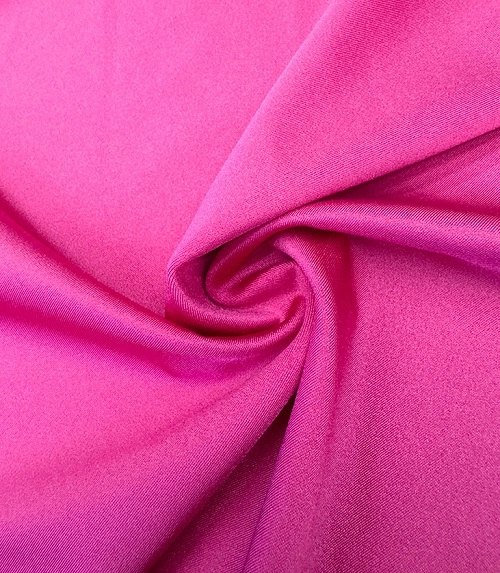
Polyester textiles dominate the global synthetic fiber market due to their strength, versatility, and value. Among the many polyester variants, 50D Bright Polyester Textile holds a unique place—offering a balance of durability, luster, and performance that makes it ideal across a wide range of applications.
What Is 50D Bright Polyester Textile?
50D refers to the denier of the polyester filament—specifically, a fiber that weighs 50 grams per 9,000 meters. The term “Bright” denotes a finished yarn or textile with a high surface sheen and reflectivity, achieved through specific spinning and finishing techniques.
In essence:
- Polyester: A synthetic polymer typically made from polyethylene terephthalate (PET).
- 50 denier: A medium-light filament with balanced strength and flexibility.
- Bright finish: A smooth, lustrous surface that reflects light, giving the textile an appealing sheen.
The Chemistry Behind Polyester
Polyester is a thermoplastic polymer derived from condensation polymerization between ethylene glycol and terephthalic acid. The resulting PET molecules align into long chains, which are then extruded into fibers.
Key chemical properties include:
- High crystallinity: Enhances strength and dimensional stability.
- Hydrophobic nature: Low moisture absorption (~0.4%), improving wrinkle resistance but affecting dye uptake.
- Thermal behavior: Glass transition around 70–80 °C; melting point around 250–260 °C.
The “bright” effect is typically the result of smooth filament surfaces and controlled molecular orientation during spinning—producing higher light reflection.
Manufacturing Process
The creation of 50D Bright Polyester Textile involves several key stages:
Polymerization
- PET chips are formed via esterification/transesterification and polycondensation.
- Additives may be introduced for UV stability, lubricity, or antistatic properties.
Melt Spinning
- PET chips are melted and extruded through spinnerets to create continuous filaments.
- High-temperature control and precision spinneret design contribute to filament uniformity.
Drawing
- Filaments are stretched to align polymer chains, boosting tensile strength and reducing elongation.
- For bright finishes, controlled drawing reduces surface irregularities.
Texturizing (Optional)
- 50D can be left as flat filament (FT) for maximum sheen, or textured (DTY/ATY) to add bulk and comfort.
- Bright polyester is more common in flat filament form to preserve luster.
Winding and Finishing
- Filaments are wound into packages for weaving or knitting.
- Finishing treatments—heat-setting, calendering—enhance dimensional stability and sheen.
Technical Characteristics
Physical and Mechanical Performance
| Property |
Typical Range / Description |
| Denier |
50D |
| Tenacity (Strength) |
High; approx. 3.5–5.5 g/d (dependent on processing) |
| Elongation at Break |
Moderate, ~20–30% |
| Elastic Recovery |
Excellent; low permanent set |
| Moisture Regain |
~0.4% (low) |
| Dyeability |
Moderate to good with disperse dyes |
| Surface |
Smooth, high sheen (bright finish) |
Thermal and Chemical Behavior
- Melting Point: ~250–260 °C
- Heat Resistance: Excellent dimensional stability up to ~150–180 °C
- Chemical Resistance: Good resistance to many solvents and acids; attacked by strong oxidizers.
Performance Advantages
Strength and Durability
50D polyester demonstrates high tensile strength and abrasion resistance—key attributes for products requiring long-term structural integrity.
Aesthetic Appeal
The bright finish provides a reflective, glossy surface valued in fashion, interior textiles, and decorative applications.
Low Moisture Absorption
Hydrophobic nature results in quick-drying textiles with minimal shrinkage and excellent wrinkle resistance.
Shape Retention
High elasticity recovery prevents bagging and distortion in garments and technical applications.
Chemical and UV Resistance
With appropriate additives, 50D polyester can resist UV degradation and many chemicals, expanding its outdoor usability.
Common Applications
Apparel & Fashion
- Lightweight garments: shirts, dresses, sportswear linings
- Fashion trims and accents requiring sheen
- Cost-effective alternatives to silk-like textiles
Industrial & Technical Textiles
- High-performance linings
- Flags and banners (bright appearance)
- Safety and reflective fabrics
Home & Interior
- Curtains, draperies, upholstery coverings
- Decorative ribbons and weave-in trims
Outdoor and Sports
- Lightweight backpacks and tents (as part of fabric blends)
- Paragliders and kites where low weight and strength matter
Testing and Quality Standards
To ensure material performance and conformity, 50D Bright Polyester is evaluated using international textile standards:
- ASTM D2256: Tensile properties of yarns
- ISO 13934-1: Tensile strength of fabrics
- AATCC 135 / ISO 105: Colorfastness to perspiration, light, washing
- ASTM D1424: Tear resistance tests
Bright polyester textiles also undergo visual and spectrophotometric assessment to quantify sheen and color uniformity.
Dyeing and Finishing Considerations
Dyeing
Polyester requires high-temperature dyeing with disperse dyes due to its hydrophobic nature.
Factors influencing dye uptake include:
- Molecular arrangement/dye diffusion
- Carrier chemicals or supercritical CO₂ systems
- Temperature control
Bright polyester often demands specialized dyeing to maintain luster and avoid haze.
Finishing
- Heat-setting: Stabilizes dimensions and reduces shrinkage.
- Calendering: Smooths the surface for higher sheen.
- Coating/Lamination: Provides functional barriers (e.g., water resistance).
Finishes must balance aesthetic qualities with functional demands (e.g., breathability vs. water repellency).
Sustainability and Environmental Impact
Polyester’s Ecological Footprint
Polyester is derived from petrochemicals, raising concerns about:
- Fossil fuel dependency
- Energy intensity of production
- Microplastic shedding during washing
Recycling and Circularity
PET is widely recycled through:
- Mechanical recycling: Regrinding and re-extrusion of bottles and textiles.
- Chemical recycling: Breaking PET into monomers for repolymerization.
Recycled polyester (rPET) can be utilized to produce 50D fibers, reducing virgin raw material use and emissions.
Challenges and Limitations
While 50D Bright Polyester has many strengths, it has limitations:
- Low moisture wicking without treatment
- Heat retention may be undesirable in hot climates
- Environmental concerns tied to microplastics and non-biodegradability
- Dyeing complexity requiring specialized equipment
Future Trends and Innovations
Emerging directions for 50D poliester textiles include:
- Bio-based polyester from renewable feedstocks (e.g., plant-derived monomers)
- Advanced functional finishes, including antimicrobial, moisture-management, and self-cleaning coatings
- Circular textile systems linking design, recycling, and reuse
- Smart textiles integration for wearables and sensing applications
50D Bright Polyester Textile strikes a compelling balance of strength, aesthetics, processability, and performance. Its bright finish and medium denier make it suitable for a wide array of fashion, industrial, and technical uses. While sustainability challenges remain, advances in recycling and materials science are expanding its potential role in a future textile economy.